Listening First on Local Taxes
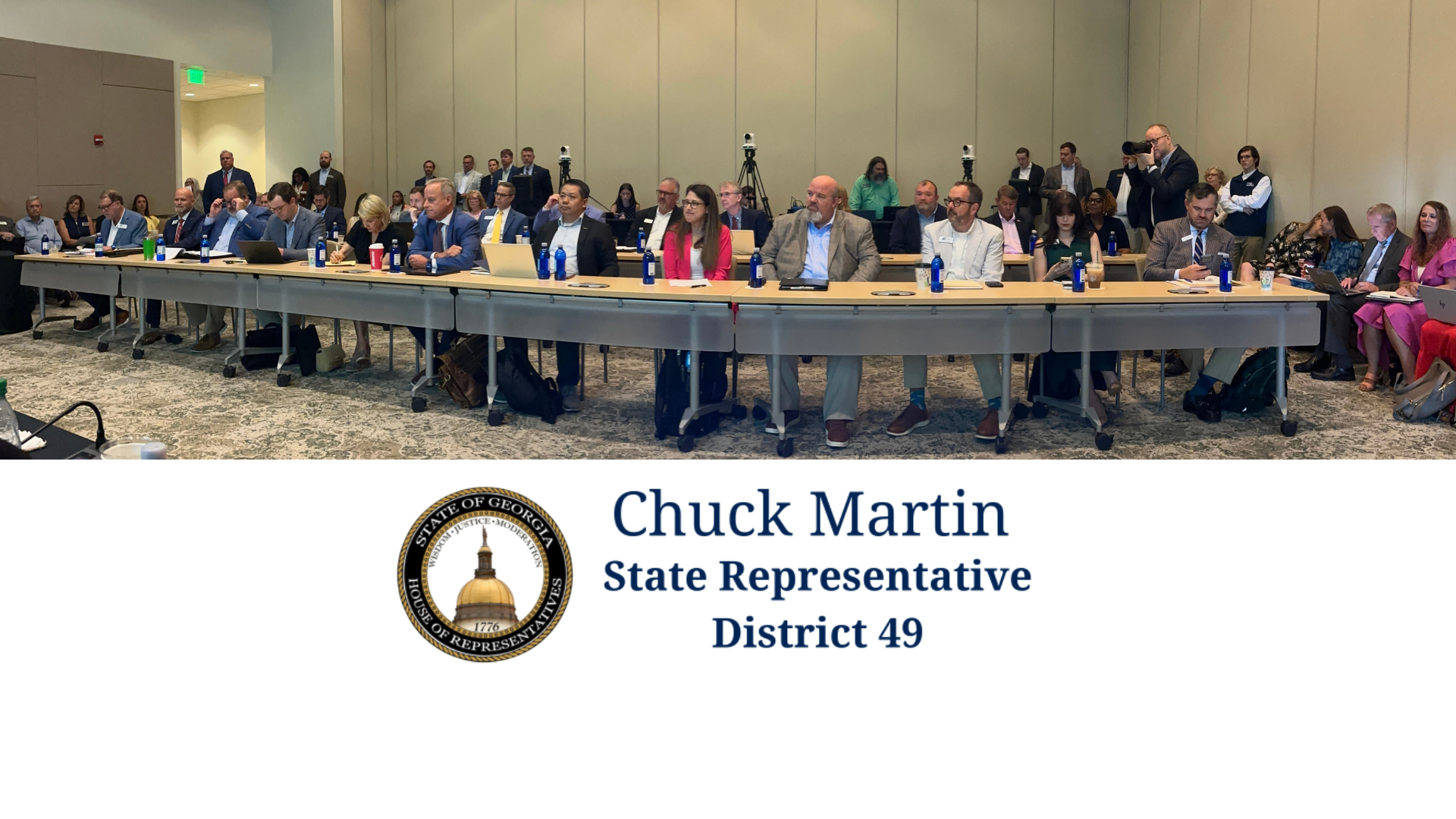
The first meeting of the Blue-Ribbon Study Committee on Local Government Taxation, Funding, and Budgeting.
Why does a property tax bill keep climbing when the millage rate has not moved?
That question is on the table this summer, and it is the reason the Speaker created the House Blue-Ribbon Study Committee on Local Government Taxation, Funding, and Budgeting. I was asked to serve on it.
The committee held its first meeting on July 22 in Cartersville, chaired by Representative Chas Cannon of Moultrie. The Georgia Municipal Association and the Association County Commissioners of Georgia were among those who testified, and rising costs came through as a top concern for city and county governments across the state.
A first meeting is for listening, and that is what we did. Before this committee recommends anything, it needs a clear picture of how local revenue actually works in Georgia, where the pressure points are, and what taxpayers can reasonably expect in transparency from the governments closest to them.
Here is why this one matters at home.
In the cities of Alpharetta, Roswell, and Milton, and for the Fulton County Board of Education, we answered that opening question back in 2018. Homeowners were watching assessments climb year after year while being told the tax rate had not changed. So I wrote the floating homestead exemption legislation used for each of our three cities, and our neighbors approved it at the ballot box. The principle is plain: your exemption rises with your assessment, less an adjustment for inflation, so the value your city tax bill is based on stays level. A reassessment does not quietly become a tax increase nobody voted for.
North Fulton was early on this. Not because anyone at the Capitol suggested it, but because our residents asked for it and our cities were willing to go first.
So when this committee takes up how local revenue ought to work statewide, Alpharetta, Roswell, and Milton are not bringing a theory to the table. We have lived under this for years. We know what it protects, what it costs a local budget, and where the hard edges are. That is worth something in a room full of people still framing the problem.
The committee will meet again through the fall, and I will report back after each one. If you have a view on how local budgets and assessments should be explained to the people paying the bill, send it to me at chuck.martin@house.ga.gov. I would rather hear from you before the recommendations are written than after.
Updates from Chuck